Boris Yvain
The King in YellowBoris Yvain is an American-born sculptor whose artistic ambition and experimental discovery transform marble from a medium of representation into an active, dangerous force. Celebrated for his work yet driven toward an unprecedented achievement, he discovers a solution that petrifies organic matter almost instantaneously. His attempt to master that discovery ends in Geneviève’s death, his suicide, and the deliberate destruction of his formula and records, leaving his achievement both materially preserved and historically erased.
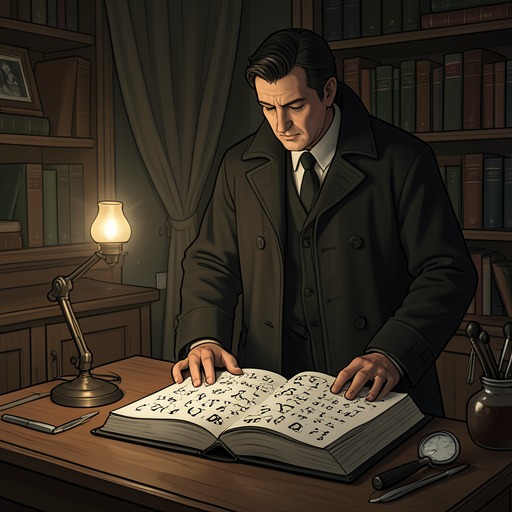
Identity and Artistic Standing
Boris Yvain was born in America to a French father and a Russian mother, a background that gives him a distinct place among the artists of the Beaux Arts. He is known familiarly as Boris, but only Alec and Jack Scott receive the same intimate form of address from him. Their closeness is strengthened by shared artistic life and by the pride they take in claiming him as an American-born friend.
His reputation rests especially on the marble Madonna for which Geneviève sat. The work had been the sensation of the previous year’s Salon, establishing Boris as an artist from whom the public expected more than competent academic craftsmanship. His Ariadne, though technically magnificent, seemed inadequate beside that triumph. More important still was the unfinished group of the Fates: a splendid and terrible work emerging only partly from the surrounding marble, yet impossible to complete in time for the Salon. The contrast between the finished Madonna, the conventional Ariadne, and the waiting Fates defines Boris as an artist caught between public success and a more dangerous, unfinished vision.
The Petrifying Discovery
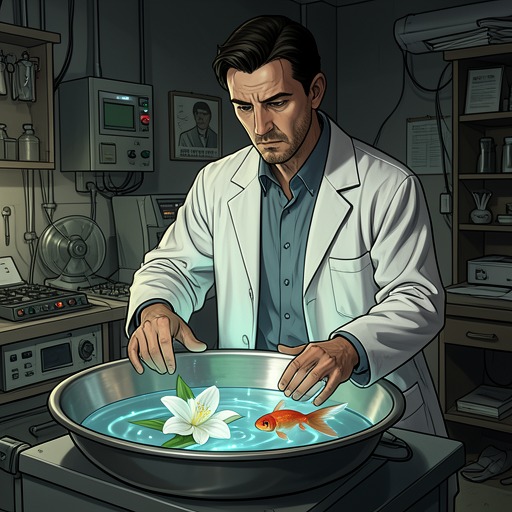
Boris’s decisive achievement is a chemical solution capable of doing in a second what naturally occurring silica-rich mineral springs accomplish over years. The process replaces vegetable matter with silica, producing a stone duplicate of the original object. Boris has investigated this phenomenon out of curiosity and accidentally discovered a far more violent solution, together with a new element precipitated in metallic scales. He is so alarmed by the implications that he calls the discovery a vicious innovation capable of corrupting the entire world of art and refuses to entrust the secret to anyone.
The solution’s operation is demonstrated through an Easter lily that Geneviève brought that morning from Notre Dame. When Boris drops the flower into the basin, the liquid loses its crystalline clarity, surrounds the lily with milk-white foam, and becomes opalescent as orange and crimson colors move across its surface. A ray of pure sunlight-like brightness then appears beneath the flower. Boris recognizes that golden ray as the signal to remove it, and the lily emerges as flawless marble. The ordinary flower is no longer merely an object placed in a liquid; it becomes the visible measure of the solution’s agency, while Boris’s skill consists in knowing the precise moment at which to intervene.
The transformed lily also exposes the temptation at the heart of Boris’s discovery. He presents it as a perfect natural model that no sculptor could reproduce, yet the result is neither ordinary nature nor ordinary sculpture. It is a copy made by matter itself, produced through a chemical violence that bypasses artistic labor. Boris’s discovery therefore promises an apparent victory over the limits of sculpture while threatening to make the sculptor’s craft irrelevant or to place an uncontrollable material power in the service of art.
Love, Art, and the Fates
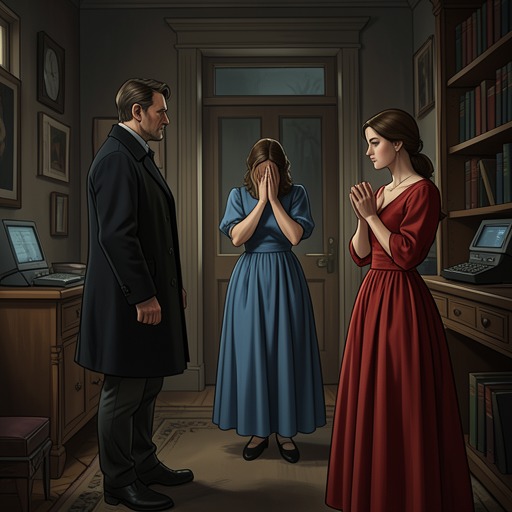
Boris is Geneviève’s lover, although the relationship is complicated by Alec’s unspoken love for her. After Geneviève tells Alec through tears that she loves Boris, Alec visits Boris and congratulates him. The interview remains perfectly cordial, but its cordiality does not conceal the emotional knowledge shared by the two men. Boris understands Alec’s position, and their friendship survives the triangle without becoming emotionally simple. Geneviève and Boris apparently never discuss the matter together, yet Boris’s awareness makes the relationship an unspoken burden within their circle.
Boris’s artistic work becomes inseparable from this emotional conflict. While working on the Fates, he is observed by Alec in the studio, absorbed in a group that has not yet emerged fully from the marble. Later, after Geneviève has been drugged and is described as having lost her mind, Boris continues working in silence. The third figure, the one looking straight ahead over the world, comes to bear Boris’s face—not the face his friends knew, but the face he has at that moment and retains until the end. The sculpture thus becomes a displaced portrait of Boris at the limit of his powers, joining his artistic identity to an image of foreknowledge, fixation, and irreversible doom.
Death and Erasure
The final sequence is reported by Jack Scott after Alec learns that Boris and Geneviève are both dead. Boris works on the Fates until nearly midnight while Geneviève sleeps under the influence of drugs. A door opens and shuts sharply; a rush is heard in the adjoining room. Boris and Jack reach the room too late and find Geneviève at the bottom of the pool with her hands across her breast. Boris then shoots himself through the heart.
Jack’s response turns Boris’s death into an act of containment as well as mourning. He carries Boris to his room, drains the pool of the petrifying fluid, and turns on all the water to wash the marble clean of every drop. He then empties the basin, pours out the contents of every jar and bottle, burns Boris’s papers, notebooks, and letters, smashes the empty bottles, and carries their fragments to the cellar furnace in repeated trips until nothing remains that could help recover the formula. The discovery is therefore destroyed not by scientific refutation but by deliberate ethical and fearful suppression.
Boris is buried in the little cemetery of Sèvres. Jack and the doctor conceal the circumstances from the public, dismissing the servants and allowing them to believe that Boris and Geneviève have gone traveling in distant lands. The doctor supplies a certificate attributing Boris’s death to heart disease. Boris’s public legacy is consequently divided: the celebrated sculptor survives in reputation, while the petrification formula, the laboratory records, and the truth of his final hours are erased.
Narrative and Thematic Significance
Boris embodies the collision of artistic creation, scientific mastery, and material danger. His greatest discovery appears to offer an absolute form of imitation: a living flower can become flawless marble without the sculptor reproducing it by hand. Yet the same process converts art into an encounter with a force that cannot be safely separated from death. The lily’s beauty and the pool’s later association with Geneviève’s corpse bind aesthetic perfection to irreversible destruction.
His unfinished Fates deepen that pattern. The group is both an artistic project and a visual prophecy, with Boris’s own altered face appearing on the figure that looks beyond the world. The work remains incomplete, but it records the crisis more faithfully than any finished public sculpture could. Boris’s death completes the tragic movement that the statue only anticipates: the artist who seeks to command transformation is finally overtaken by it, and the evidence of his command is destroyed along with the man himself.